Why MVC in MERN Stack is Your Secret Weapon
If you’ve ever built a MERN app, you’ve probably felt it.
Your code starts small. Works fine. Then suddenly, a new feature breaks three other parts of your app.
You’re asking yourself: “How did this get so messy?”
Welcome to the real reason developers love MVC—and why it works perfectly in the MERN stack.
What MVC Really Means (And Why It Matters)
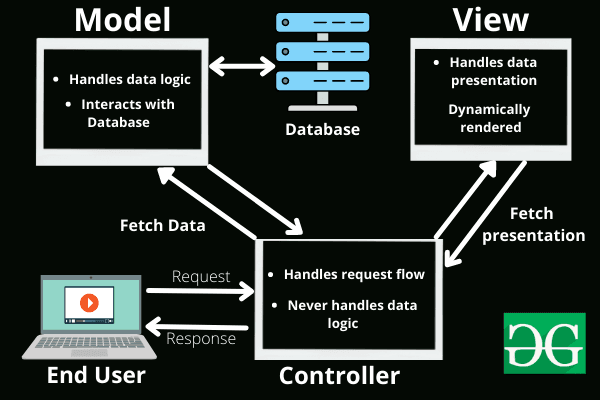
MVC stands for Model, View, Controller.
- Model: Your data. MongoDB lives here. Schemas, validations, relationships.
- View: What the user sees. React components, pages, templates.
- Controller: The brain. Node.js/Express routes, business logic, API calls.
MVC isn’t just a diagram you copy from a textbook. It’s a discipline that keeps your app organized. Imagine it as a city:
- MongoDB is the warehouse storing your goods.
- Express/Node.js is the logistics manager.
- React is the shopfront where your customers see your products.
When each part has its role, chaos disappears.
Why MERN Without MVC Feels Messy
I’ve been there. You start building. React components call APIs directly. Node.js files mix database logic and route handling. At first, it works. But by the time you add authentication, payments, and a dashboard, your codebase looks like spaghetti.
Future you hates past you. MVC saves you from that. Separation of concerns isn’t just theory—it’s sanity.
How to Structure MVC in MERN
Here’s one way I organize a MERN app:
- Models:
models/folder. MongoDB schemas. Validation logic lives here. - Controllers:
controllers/folder. Functions for handling requests. Don’t touch the view. Don’t touch the DB directly—call the model. - Routes:
routes/folder. Express routes call controllers. Keep it thin. - Views (React):
client/src/folder. Components consume APIs, show data, no business logic.
Pro tip: Keep your controllers small. If a function grows beyond 20–30 lines, split it. Small controllers = easy testing = fewer bugs.
The Hidden Benefit: Scaling Made Easy
MVC isn’t just about neat folders. It makes teams efficient. Backend devs work on controllers and models. Frontend devs work on React. Everyone knows where to find what.
Adding features? Easy. Testing? Easy. Debugging? Almost fun.
Think long-term: your app grows, your code doesn’t implode.
Hooks to Keep You Engaged
- Every route has a single responsibility. One route = one action.
- Models never talk to React. React never talks to MongoDB. Controllers mediate.
- Structure is your productivity hack. Without it, every feature is a minefield.
When MVC Might Feel Overkill
For tiny prototypes, yes. MVC might feel like extra work. But the moment your app grows beyond a few components or endpoints, you’ll thank yourself. MVC scales with complexity. Chaos doesn’t.
The Bottom Line
MVC in the MERN stack isn’t just a pattern you learn in school. It’s a discipline. A scaffold for creativity. It keeps your app maintainable, your team sane, and your future self happy.
Want your MERN app to survive the long game? Learn MVC. Structure it. Stick to it.